The first Christian nation on earth — a people whose faith, language, and memory have outlasted every empire that sought to erase them.
First Christian State · 301 ADAn Alphabet Born for Scripture · 405 ADGenocide & Survival · 1915A Living Faith Today
Prologue
A Nation Forged in Faith and Fire
To understand Armenia is to understand a paradox: a people scattered across the world, yet bound by an unbreakable thread of faith, language, and memory. For more than three thousand years, the Armenian people have lived at the crossroads of empires — Persian, Roman, Byzantine, Arab, Mongol, Ottoman, Russian, Soviet — and each in turn has tried to absorb, convert, or destroy them. Each in turn has failed.
The reason for that survival is not military strength; Armenia has rarely possessed it. It is something subtler and more durable: a civilization whose deepest identity is woven from its Church, its alphabet, and its memory. This is the story of that civilization — of the world's first Christian nation, of the catastrophe that nearly ended it, and of the voices that refuse to let the world forget.
✦ Part One ✦
The Armenian Apostolic Church
Founded by apostles, sealed by a king, written into an alphabet — Christianity's oldest national church.
Chapter I · The Apostolic Foundation
Built on the Witness of Apostles
The Armenian Apostolic Church — in Armenian, Հայ Առաքելական Եկեղեցի (Hay Aṛakelakan Yekeghetsi) — derives its very name from the claim that stands at its heart: it was founded by the apostles of Jesus Christ himself. According to ancient and unbroken tradition, two of the Twelve — St. Thaddaeus (Jude) and St. Bartholomew — traveled to Armenia in the first century to preach the Gospel, and both were martyred on Armenian soil. Their missions, traditionally dated to roughly 43–66 AD, give the Church its title Apostolic and its sense of direct descent from the first eyewitnesses of the Resurrection.
Two of Armenia's most ancient monasteries — St. Thaddeus (the "Black Church," Qara Kelisa, in present-day Iran) and St. Bartholomew — mark the traditional sites of their ministry and martyrdom, and remain pilgrimage destinations to this day.
301 AD — The First Christian Nation
While individual Armenians had been Christian for generations, the decisive moment came at the dawn of the fourth century. In 301 AD, the Kingdom of Armenia under King Tiridates III (Trdat) formally adopted Christianity as the state religion — making Armenia, by the reckoning of historians, the first nation in the world to do so, more than a decade before Constantine's Edict of Milan granted Christians mere tolerance within the Roman Empire.
The figure at the center of this transformation was St. Gregory the Illuminator (Սուրբ Գրիգոր Լուսավորիչ, Surb Grigor Lusavorich). Gregory was the son of a nobleman who had assassinated Tiridates' father. When his identity was discovered, the king had him cast into the Khor Virap — a deep, snake-infested pit near Mount Ararat — where, according to tradition, he survived for approximately thirteen years, kept alive by a pious widow who lowered bread to him.
When the king fell gravely ill — described in the hagiographies as being driven to madness and bodily affliction — it was revealed in a vision that only Gregory could heal him. Released from the pit, Gregory cured the king, converted the royal court, and baptized the nation. Consecrated as the first Catholicos of All Armenians, he founded the cathedral of Holy Etchmiadzin on a site he is said to have seen in a vision — where Christ himself descended with a golden hammer to mark the spot. The name Etchmiadzin means "the Only-Begotten descended here."
"Armenia was not given Christianity. Armenia chose it — and then chose to die for it, again and again, rather than surrender it."
— A summary of the Armenian Christian self-understanding
405 AD — An Alphabet Created for Scripture
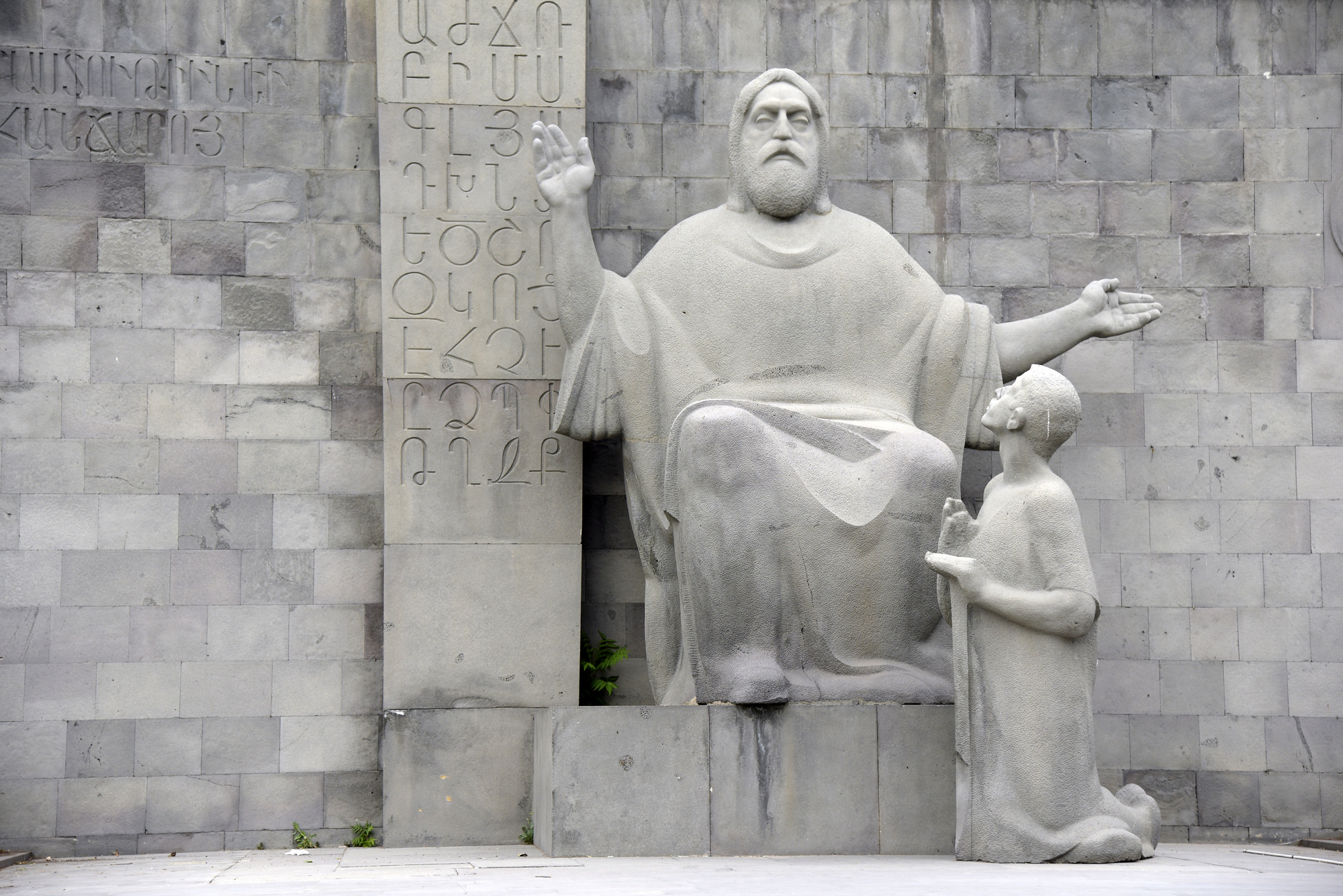
A century after the conversion, the Church faced a crisis of identity: the liturgy and Scriptures were read in Greek and Syriac, languages the common people did not understand, and Armenia risked cultural absorption by its powerful neighbors. The solution was one of the most remarkable acts in the history of any nation. Around 405 AD, the monk and scholar St. Mesrop Mashtots (Մեսրոպ Մաշտոց), with the backing of Catholicos Sahak the Great and King Vramshapuh, created an entirely new Armenian alphabet — 36 original letters (later expanded to 38) designed specifically to capture the sounds of the Armenian language.
Its first and primary purpose was sacred: to translate the Bible into Armenian. The very first sentence ever written in the new script was, fittingly, a line from the Book of Proverbs — "To know wisdom and instruction, to perceive the words of understanding" (Proverbs 1:2). The translation of the Bible that followed is so elegant it has been called the "Queen of Translations" (Թարգմանչաց). The Church still celebrates the Feast of the Holy Translators as one of its great national holidays — a culture that venerates its translators as saints.
What followed was a "Golden Age" (Voskedar) of Armenian literature in the fifth century: original histories, theology, poetry, and philosophy poured forth. The alphabet did exactly what it was designed to do — it made the Armenian people unassimilable. For sixteen centuries since, through statelessness and dispersion, the script has been the spine of Armenian identity.
1st century AD
Apostles Thaddaeus and Bartholomew evangelize Armenia and are martyred there
c. 287 AD
St. Gregory the Illuminator imprisoned in the pit of Khor Virap
301 AD
King Tiridates III declares Christianity the state religion — Armenia becomes the first Christian nation
c. 303 AD
Cathedral of Holy Etchmiadzin founded — the oldest cathedral in the world
405 AD
St. Mesrop Mashtots creates the Armenian alphabet; the Bible is translated
5th century
The Golden Age of Armenian literature flourishes
506 AD
Synod of Dvin — Armenia formally declines the Council of Chalcedon, becoming Oriental Orthodox
Chapter II · Belief, Structure & Sacred Art
The Living Body of the Church
What the Armenian Church Believes
The Armenian Apostolic Church belongs to the family of Oriental Orthodox churches — alongside the Coptic, Ethiopian, Syriac, Eritrean, and Malankara Indian churches. It shares the ancient apostolic faith with all of Christianity: belief in the Holy Trinity, the Incarnation, the death and resurrection of Christ, and the sacraments. Its distinctive feature is Christological: it follows the Miaphysite formula of St. Cyril of Alexandria — that in the incarnate Christ, divinity and humanity are united in "one nature, united and without confusion."
This is often misunderstood. Miaphysitism is not the heresy of Monophysitism (which denies Christ's true humanity). The Armenian Church confesses Christ as fully God and fully human; its difference with the churches that accepted Chalcedon (451 AD) was always one of theological vocabulary rather than substance — a fact that modern ecumenical dialogue has formally recognized in joint declarations with the Catholic, Eastern Orthodox, and Protestant churches.
The Catholicos and the Holy See
The supreme spiritual head of the Armenian Church bears the title Catholicos of All Armenians (Ամենայն Հայոց Կաթողիկոս), seated at the Mother See of Holy Etchmiadzin in Armenia. Alongside it stands the Catholicosate of the Great House of Cilicia (based in Antelias, Lebanon), and two historic Patriarchates — of Jerusalem (custodian of the Armenian Quarter and the Cathedral of St. James) and of Constantinople. All are united in one faith and one liturgical tradition.
The Badarak — the Divine Liturgy
The heart of Armenian worship is the Badarak (Պատարագ), the Divine Liturgy — a continuous tradition reaching back to the fifth century, celebrated in Classical Armenian (Grabar). It is among the most ancient and musically rich liturgies in all of Christianity, filled with hymns called sharakans composed by the great poet-theologians of Armenian history, including the towering figure of St. Gregory of Narek (Grigor Narekatsi), whose 10th-century Book of Lamentations is a masterpiece of world spiritual literature. In 2015, the Catholic Church declared him a Doctor of the Universal Church.
The Khachkar — Armenia's Stone Sermons
No art form is more distinctively Armenian than the khachkar (խաչքար, literally "cross-stone") — intricately carved stone steles bearing a cross surrounded by interlacing patterns, vines, rosettes, and geometric lacework of staggering complexity. No two are alike. Thousands stand across Armenia and the historic Armenian lands, each one a prayer worked in stone. UNESCO inscribed the symbolism and craftsmanship of the khachkar on its list of Intangible Cultural Heritage of Humanity in 2010.
⛪
Holy Etchmiadzin
The world's oldest cathedral (c. 303 AD) and seat of the Catholicos; a UNESCO World Heritage Site
📜
The Matenadaran
Yerevan's repository of over 23,000 ancient Armenian manuscripts — among the greatest archives on earth
🏔️
Khor Virap
The "deep pit" where St. Gregory was imprisoned, beneath the gaze of Mount Ararat
✝️
The Khachkar
UNESCO-listed cross-stones; thousands survive, each one carved utterly unique
Three thousand years at the crossroads of empires — from the kingdom of Urartu to the Republic of today.
Chapter III · Ancient Roots
From Urartu to the Kingdom of Armenia
The Armenian Highlands — centered on the biblical Mount Ararat, where the Book of Genesis places the resting of Noah's Ark — have been home to advanced civilizations for millennia. The kingdom of Urartu (also called the Kingdom of Van) flourished here from the 9th to the 6th century BC, leaving behind sophisticated fortresses, irrigation works, and inscriptions. The Armenian people emerged from this world, and the name "Armenia" first appears in history in the Behistun Inscription of the Persian king Darius the Great, around 520 BC. Armenians call themselves Հայ (Hay) and their country Հայաստան (Hayastan), names they trace to the legendary patriarch Hayk.
The Height of Armenian Power
Under King Tigranes II the Great (r. 95–55 BC), the Kingdom of Armenia reached its greatest extent, briefly stretching from the Caspian to the Mediterranean and rivaling Rome itself. For centuries thereafter, Armenia occupied the contested frontier between the Roman/Byzantine world to the west and the Persian world to the east — a position that brought both cultural richness and perpetual vulnerability, a theme that would define the entire Armenian experience.
"The Armenians were the buffer between two worlds — and a buffer, by its nature, absorbs the blows of both."
— A common observation of Armenian historiography
451 AD — The Battle of Avarayr
In the same year as the great Council of Chalcedon, Armenia fought one of the defining battles of its history — not for territory, but for faith. The Sasanian Persian Empire sought to force Armenia to abandon Christianity and embrace Zoroastrianism. On 26 May 451 AD, at the field of Avarayr, an outnumbered Armenian army under St. Vartan Mamikonian met the Persian forces. The Armenians were defeated on the battlefield and Vartan was killed — yet their willingness to die rather than apostatize so shook Persian resolve that, decades later, the Treaty of Nvarsak (484 AD) guaranteed Armenians the freedom to practice Christianity. Avarayr is remembered not as a defeat but as a spiritual victory, and St. Vartan is venerated as a martyr-saint. The motto attributed to that struggle endures: "Death understood is immortality."
c. 860–590 BC
Kingdom of Urartu flourishes in the Armenian Highlands
c. 520 BC
The name "Armenia" first recorded in the Behistun Inscription of Darius I
95–55 BC
Tigranes the Great expands Armenia to its greatest territorial extent
301 AD
Armenia becomes the first Christian state
451 AD
Battle of Avarayr — Armenians fight Persia for the right to remain Christian
Chapter IV · Kingdoms, Conquest & Diaspora
Statehood Lost and Reimagined
After the fall of its ancient kingdom, Armenia passed through the hands of Arab caliphates, Byzantine emperors, and Seljuk Turks. A brilliant revival came under the Bagratid dynasty (9th–11th centuries), whose capital Ani — the "City of a Thousand and One Churches" — became one of the great cities of the medieval world, its ruins still standing today on the modern Turkey–Armenia border as a UNESCO World Heritage Site.
When the Armenian Highlands fell to invasion, Armenian statehood migrated south and west to the Mediterranean coast, where the Armenian Kingdom of Cilicia (1198–1375) flourished as a crucial ally of the Crusader states and a vibrant center of Armenian culture, art, and commerce. Its fall in 1375 ended Armenian sovereignty for over five centuries.
Under Ottoman and Persian Rule
From the 16th century, the Armenian homeland was divided between the Ottoman Empire in the west and Persia (later the Russian Empire) in the east. Under Ottoman rule, Armenians were organized as a millet — a recognized but subordinate religious community. Many Armenians rose to prominence as merchants, artisans, architects, and bankers; the great imperial architect Mimar Sinan's tradition was carried on by Armenian master-builders like the Balyan family, who designed many of Constantinople's most famous palaces and mosques. Yet Armenians remained second-class subjects — and as the 19th century closed, their position grew perilous.
1915–1923 · Մեծ Եղեռն — the "Great Crime." Up to 1.5 million lives. The first genocide of the modern age.
Chapter V · The Catastrophe
Meds Yeghern — The Great Crime
What the Armenians call the Մեծ Եղեռն (Meds Yeghern, "the Great Crime") was the systematic destruction of the Armenian population of the Ottoman Empire during the First World War. Carried out primarily between 1915 and 1923 under the cover of war, it took the lives of an estimated 600,000 to 1.5 million Armenians through mass shootings, death marches into the Syrian desert, starvation, and disease. It is widely regarded by scholars as one of the first genocides of the modern era — and indeed the word "genocide" itself was coined by the jurist Raphael Lemkin, who cited the fate of the Armenians as a primary example when he created the term in 1944.
April 24, 1915 — The Beginning
The traditional starting date is the night of 24 April 1915, when Ottoman authorities arrested several hundred Armenian intellectuals, community leaders, writers, and clergy in Constantinople and deported them — most to their deaths. This decapitation of the Armenian leadership was followed by the systematic deportation of the wider population. Able-bodied men were often killed outright or worked to death in labor battalions; women, children, and the elderly were driven on foot in columns across hundreds of miles toward the deserts of Syria, where untold numbers perished from thirst, starvation, exposure, and massacre along the way. The killing was organized and directed by the ruling Committee of Union and Progress (the "Young Turks"), above all the triumvirate of Talaat Pasha, Enver Pasha, and Djemal Pasha.
Eyewitness accounts came from many quarters — Western missionaries, diplomats, and German officers allied to the Ottomans. The United States Ambassador to the Ottoman Empire, Henry Morgenthau Sr., documented the atrocities in dispatches and later in his memoir, becoming one of the most important contemporary witnesses to the destruction.
1.5MLives Lost (Est.)
Apr 24Remembrance Day
30+Nations Recognize It
1944"Genocide" Coined
The Survivors and the Diaspora
Those who survived — orphans, widows, refugees — scattered across the world, founding the great communities of the modern Armenian diaspora in France, the United States, Lebanon, Syria, Argentina, and beyond. Many were taken in by foreign missionaries and the famous "orphan rugs" woven by Armenian orphan girls stand as a testament to that period. The Church became, once again, the ark of national survival — gathering the scattered, preserving the language, and keeping the memory alive in the liturgy itself. In 2015, on the centennial of the Genocide, the Armenian Church canonized the victims as saints in the largest canonization service in history.
The Question of Recognition
To this day, the Republic of Turkey — successor to the Ottoman Empire — officially disputes the characterization of these events as "genocide," acknowledging deaths but denying systematic intent. This denial has made recognition a central cause of the Armenian people worldwide. Over thirty countries, including France, Germany, Canada, Russia, and — in 2021, under President Joe Biden — the United States, have formally recognized the Armenian Genocide, as have numerous international bodies and the majority of genocide scholars.
— Soghomon Tehlirian, at his trial in Berlin, June 1921
A survivor of the Genocide, Tehlirian assassinated Talaat Pasha — the principal architect of the destruction of his people, who had been sentenced to death in absentia by an Ottoman court-martial yet lived freely in Berlin. At his trial, the defense turned the proceedings into an indictment of the Genocide itself. After hearing the evidence, a German jury acquitted him. The case profoundly influenced Raphael Lemkin, who would later coin the word "genocide."
Chapter VI · Voices
Words That Refuse to Be Forgotten
Across a century, the Armenian Genocide has echoed in the words of those who witnessed it, those who denied it, those who avenged it, and those who learned its terrible lesson. These are among the most consequential.
"
Who, after all, speaks today of the annihilation of the Armenians?
Adolf HitlerReportedly, to his military commanders at Obersalzberg, 22 August 1939 — on the eve of invading Poland
"
I have killed a man, but I am not a murderer.
Soghomon TehlirianAt his Berlin trial for the assassination of Talaat Pasha, 1921 — he was acquitted
"
When the Turkish authorities gave the orders for these deportations, they were merely giving the death warrant to a whole race.
Henry Morgenthau Sr.U.S. Ambassador to the Ottoman Empire, in his memoir, 1918
"
It is a crime without a name.
Winston ChurchillOn atrocity of this kind — words that helped inspire Lemkin to name "genocide"
"
The Armenians of Turkey have practically disappeared.
Contemporary press reportsAs carried in Western newspapers documenting the deportations of 1915
"
I do this not for myself, but for my nation. My conscience is clear.
Soghomon TehlirianIn the spirit of his testimony — the moral defense that swayed the jury
Note on sources: Hitler's remark survives in the document (L-3) submitted at the Nuremberg trials and is widely cited, though its exact wording is debated by historians. Tehlirian's courtroom statement and the testimony of Ambassador Morgenthau are documented in the historical record. Quotations are presented as they are commonly recorded; readers are encouraged to consult the primary sources linked below.
Independence, the eternal flame, and a faith that endures across the world.
Chapter VII · Survival & Renewal
A People Who Would Not Disappear
The twentieth century did not end Armenian suffering with the Genocide. In 1920, a brief independent Armenian republic was absorbed into the Soviet Union, where the Church endured seven decades of state atheism, persecution, and the closure of monasteries — yet survived. When the USSR collapsed, Armenia declared its independence on 21 September 1991, restoring sovereign Armenian statehood for the first time in centuries and allowing the Church to return to full public life in its homeland.
Tsitsernakaberd — The Eternal Flame
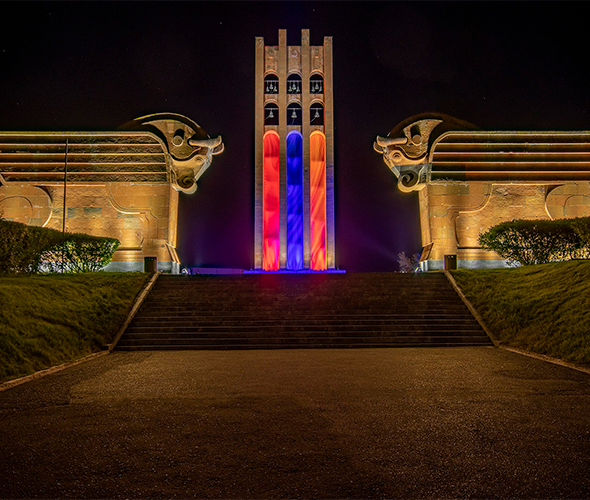
On a hill overlooking Yerevan stands Tsitsernakaberd (Ծիծեռնակաբերդ), the Armenian Genocide Memorial Complex, completed in 1967. At its heart, twelve great slabs lean inward around an eternal flame, mourning the lost. A 44-meter stele rises beside it, split in two — representing the divided Armenian people, in the homeland and in the diaspora. Each year on 24 April, hundreds of thousands ascend the hill to lay flowers around the flame, a river of remembrance that has flowed unbroken for generations.
The Global Armenian Nation
Today there are roughly 3 million people in the Republic of Armenia — and an estimated 7 to 10 million Armenians worldwide, meaning that the majority of Armenians live in the diaspora, the long shadow of the Genocide. From Glendale to Beirut, from Paris to Buenos Aires, Armenian churches remain the gathering centers of a people held together not by borders but by faith, language, the memory of Ararat, and the determination, as the saying goes, to live. The pomegranate — with its many seeds bound in a single fruit — endures as the national symbol: a scattered people, yet one.
🔥
Tsitsernakaberd
The Genocide Memorial above Yerevan, with its eternal flame and divided stele
🕊️
April 24
Armenian Genocide Remembrance Day, observed worldwide each year
🌍
The Diaspora
7–10 million Armenians worldwide; most Armenians now live outside Armenia
❧
The Pomegranate
The national symbol — many seeds, one fruit: a scattered nation, still whole
"We are few, yes. But we are called Armenians. We are a small nation that has done much."
— After the poet Paruyr Sevak's celebrated tribute to Armenian endurance
Appendix
References & Further Reading
Every external link below points to an official, governmental, museum, or academic source. Readers seeking to study any topic on this page in depth are encouraged to begin here.